
How Big Should a Tarantula Enclosure Be?
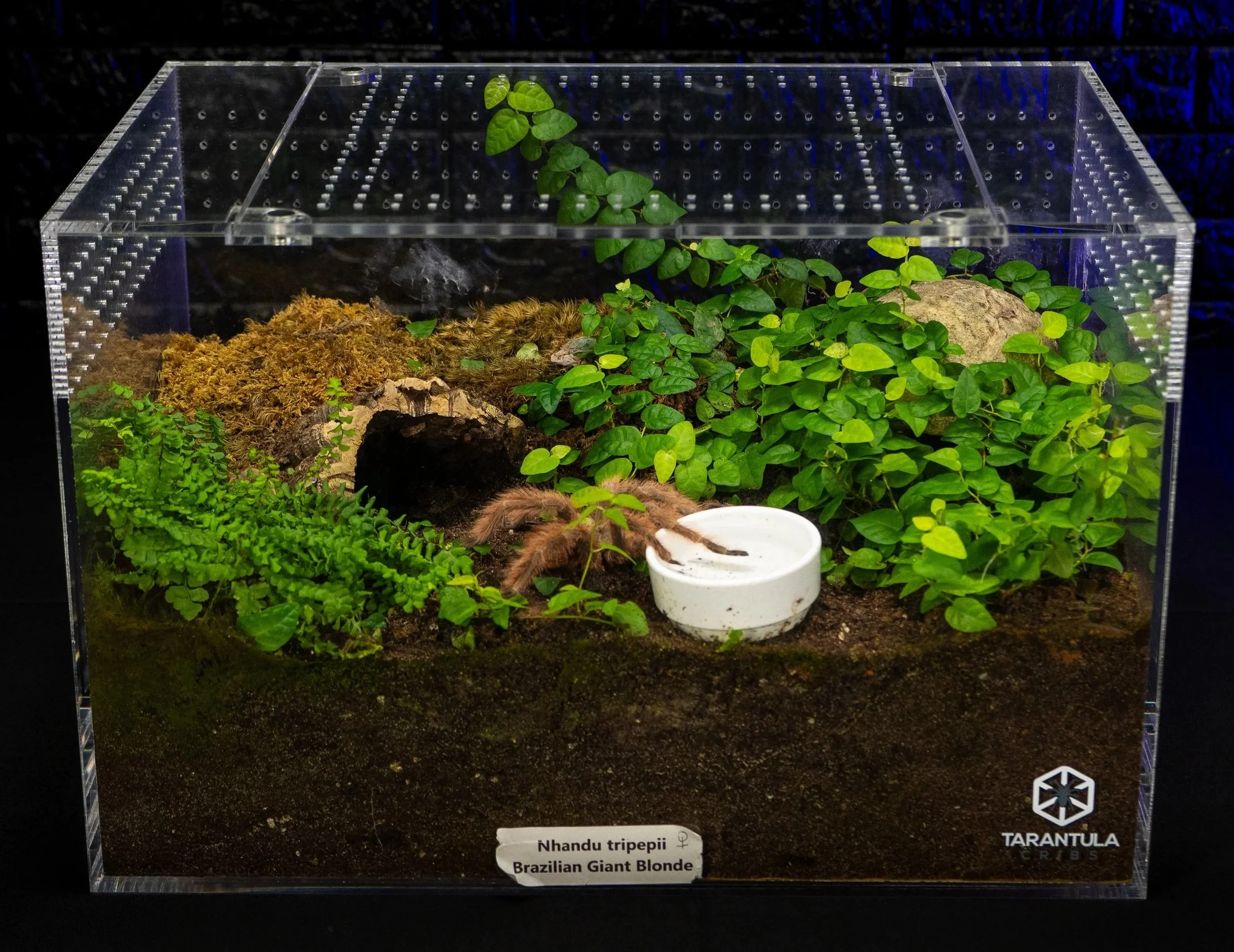
Nhandu tripepii - Brazilian Giant Blonde Tarantula enclosure
There’s a rule just about every tarantula keeper hears sooner or later: the enclosure should be about three to four times the spider’s leg span.
For terrestrial species, that usually means floor space. For arboreal species, it means more height. For fossorial species, it means enough depth for real burrowing. It’s simple, easy to remember, and in a lot of cases it works just fine.
But it’s important to understand what that rule actually is.
It’s not the ideal.
It’s the minimum.
Why Smaller Enclosures Make Sense for Spiderlings
That might sound backward to people coming from reptiles, mammals, or even fishkeeping where bigger is usually treated as automatically better. But with tiny tarantulas, a massive enclosure does not really give them freedom. Most of the time it just makes husbandry harder.
A sling in an enclosure that is way too big is harder to monitor, harder to feed, and more likely to end up in a setup where humidity swings too much and prey disappears before it gets eaten. On top of that, tiny spiderlings are much more vulnerable to slipping through ventilation or getting lost in overly complicated setups that were really designed for larger animals.
What spiderlings benefit from most is not space for the sake of space. They benefit from stability.
A smaller, appropriately sized enclosure lets you control the microclimate more easily. It helps ensure the prey is actually found and eaten. It makes water management simpler. It also makes it easier for you to notice when something is off before it becomes a real problem. For fragile little spiderlings, that consistency matters a lot more than giving them a huge enclosure they will barely use.
Why the 3x-4x Rule Works for Juveniles and Adults
Giving a tarantula around three to four times their leg span provides enough space for normal movement while still keeping the enclosure easy to manage. For heavier-bodied terrestrial species, it also helps reduce fall risk by keeping things lower and more controlled. Feeding is usually easier. General maintenance is easier. There is nothing inherently wrong with keeping a tarantula in an enclosure that size if the setup is correct for the species. A spider can absolutely live a full, healthy life in that kind of setup.
But this is where the conversation usually stops too early.
Because “big enough to work” and “best possible setup” are not the same thing.
Minimum Standards vs Thoughtful Design
Over time, I’ve shifted the way I think about enclosure size.
Instead of asking, “What is the smallest acceptable enclosure for this spider?” I think the better question is, “How much space would let this animal show a wider range of natural behaviors?”
That change in mindset makes a big difference.
For a lot of terrestrial species, I now prefer something more in the range of four to five times the leg span when possible. Sometimes even larger for moderate-sized species if I want to build out a more naturalistic or bioactive setup. Not because the spider needs a giant enclosure just to survive, but because the extra space gives me room to create something more functional than just a box with substrate and a hide.
That extra room allows for better substrate depth, more structure, better moisture retention, more cover, and more meaningful environmental variation. In other words, it gives you the chance to create a setup that behaves more like an ecosystem and less like storage.
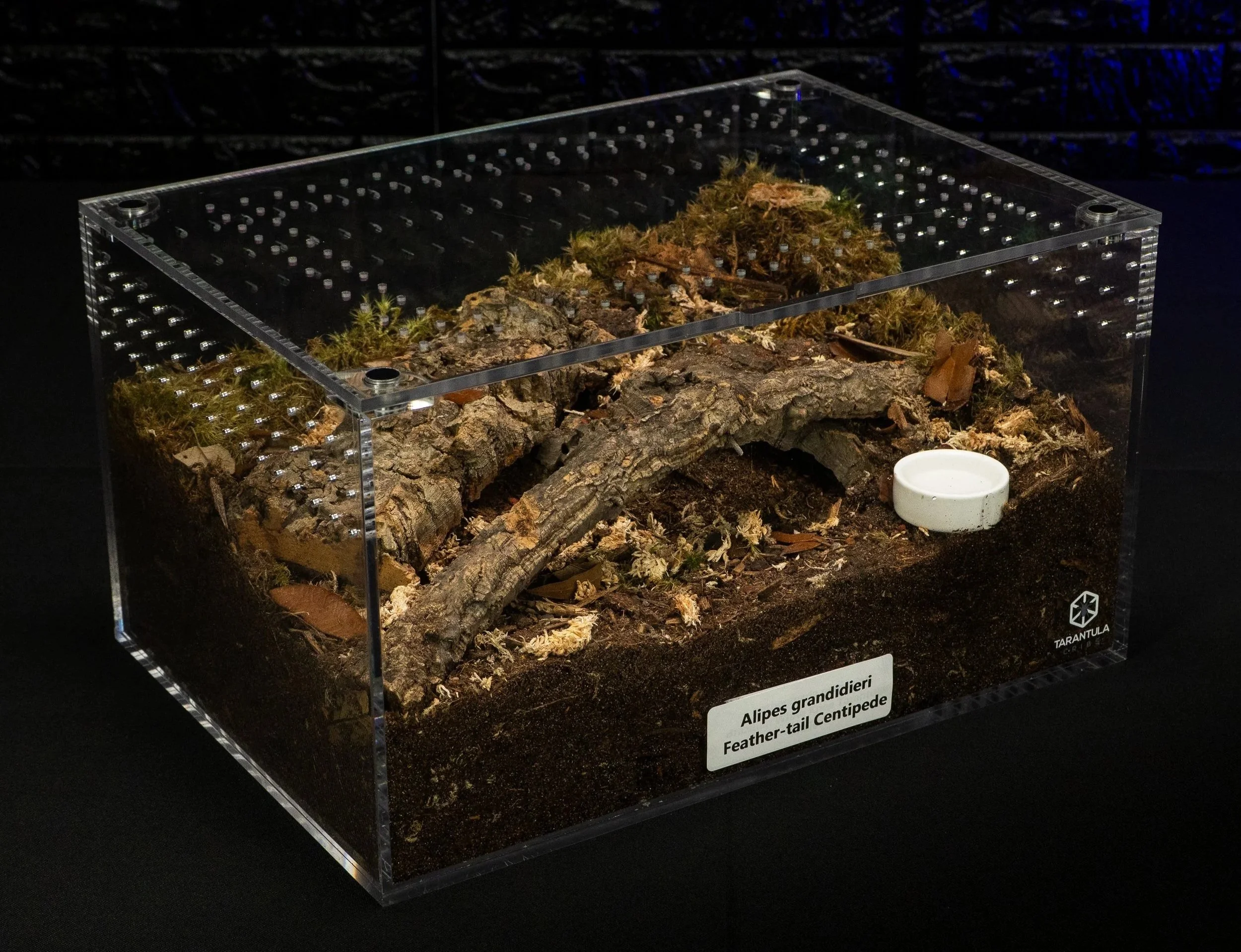
Alipes grandidieri - Feather-tail Centipede enclosure
Why Larger Naturalistic Setups Can Be More Functional
When you use a substrate that holds moisture well and supports burrowing, you can build deeper and more stable soil layers. Add surface litter, moss in the right species setups, and plants suited to the environment, and now the enclosure starts doing more than just housing the spider. It starts buffering humidity, holding structure, and creating small environmental gradients the animal can actually use.
That matters a lot with tropical genera like Poecilotheria, Theraphosa, Pamphobeteus, and Xenesthis. In those kinds of setups, a larger enclosure is not just about aesthetics. It becomes a functional tool.
More floor space and substrate depth give roots a chance to establish. Plants help regulate moisture through transpiration. Moss and litter help buffer environmental swings. And a larger volume of substrate and air tends to create a more stable microclimate overall, where humidity and temperature changes happen more gradually instead of abruptly.
That kind of stability benefits the spider, but it also benefits the enclosure itself. Everything tends to work better when the system has enough space to function.
Tarantulas Benefit From Environmental Choice
There is not a lot of published research specifically telling us the “perfect” enclosure size for captive tarantulas. But there is a broader body of invertebrate welfare research showing that environmental complexity can increase behavioral diversity and reduce stress-related behaviors. The exact details vary by species and study, but the general takeaway is pretty consistent: more structure and more choice tend to create more natural behavior.
And even if tarantulas are not out there doing laps around the enclosure like a lizard, they still respond to environmental variation.
They choose retreat sites.
They adjust burrow depth.
They position themselves differently based on moisture and temperature.
They use cover.
They modify the space around them.
A really basic enclosure with flat, inert substrate can absolutely keep a tarantula alive. But it does not offer much in the way of options. There may be one hide, one texture, one moisture level, and not much else. It’s a static box.
When you give them a larger, better-designed setup, you start creating microclimates. One side may be slightly more humid. Another slightly drier. One retreat may feel tighter and more secure. Another may be warmer or cooler. That gives the tarantula room to self-regulate instead of just passively enduring whatever one set of conditions you chose for the entire enclosure.
In the wild, tarantulas are constantly making small adjustments like that. They move deeper into a burrow. They sit closer to the entrance. They choose a different retreat. We can’t recreate the wild perfectly, but we can at least give them some opportunity to make similar choices.
Bigger Is Not Always Better for Every Species
Not every species is going to use every inch of extra space every day. And not every setup needs plants, moss, or a full bioactive system to be good husbandry. Arid species especially do not need to be dropped into a giant tropical build just because it looks cool.
But even desert species can benefit from thoughtful design. Multiple hide options, useful substrate depth, visual cover, and subtle environmental variation still matter. A dry setup does not have to mean a flat layer of substrate with one cork bark half tossed on top and a water dish shoved in the corner.
There is a big difference between sterile and simple.
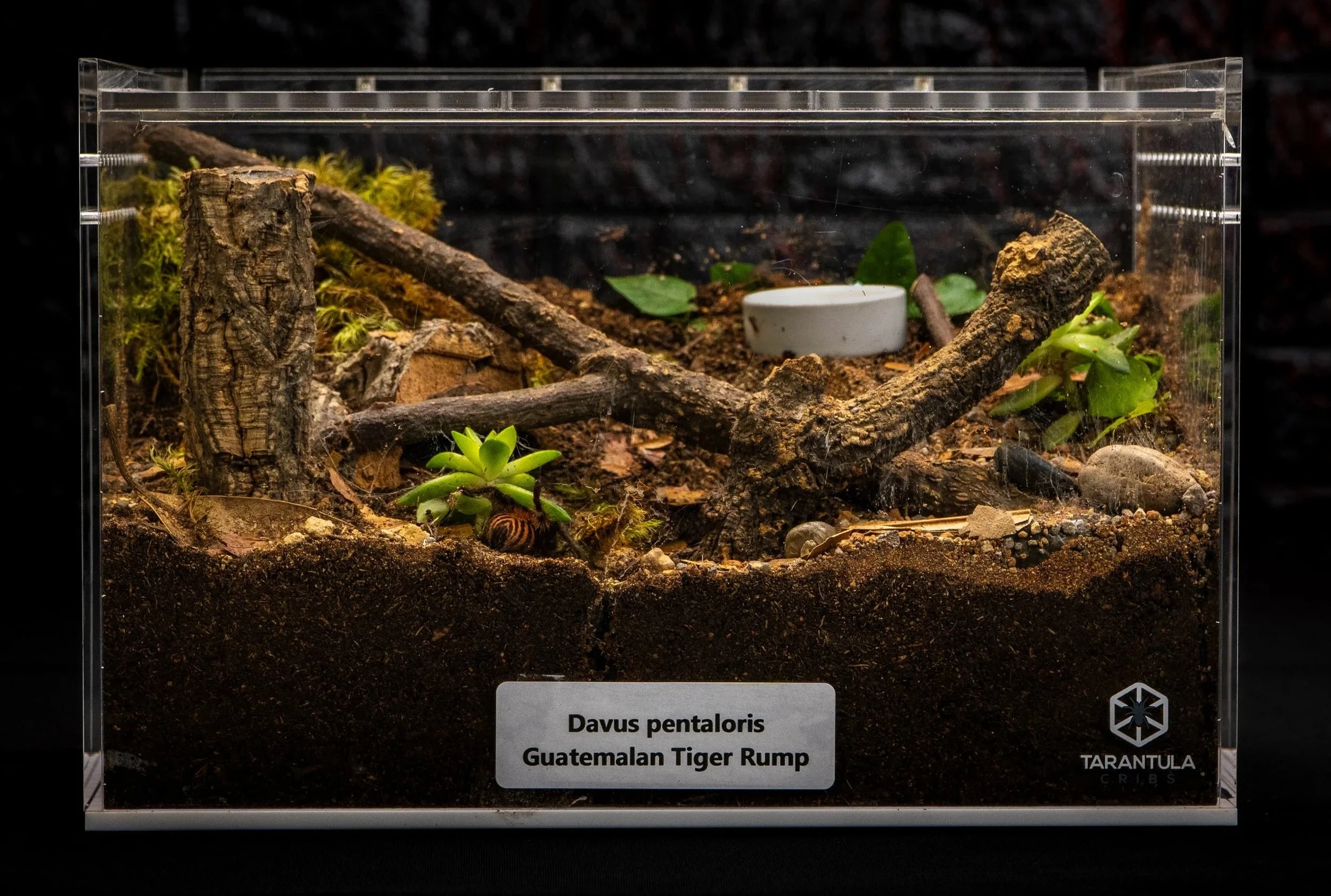
Davus pentaloris - Guatemalan Tiger Rump enclosure
The Rule Tells You How Small You Can Go, Not How Well You Can Do
The 3-to-4-times-leg-span rule is a solid minimum guideline. It tells you how small you can go while still giving the tarantula enough usable space to live safely and be managed practically. It works. There is nothing wrong with it. Some of my tarantulas are currently in enclosures based on that rule.
But it does not tell you what the best enclosure would be if your goal is to encourage more natural behavior, build a more stable system, or create something that looks and functions more like a slice of that animal’s native habitat.
If your priority is efficiency, space-saving, and straightforward maintenance, the traditional rule is perfectly fine.
If your priority is intentional design, more environmental complexity, and giving the spider more opportunities to interact with the setup in meaningful ways, you will probably end up going larger.
And in my experience, when you give tarantulas more thoughtful space, they use it.
They dig more naturally.
They choose different retreat spots.
They respond to gradients.
They engage with the enclosure instead of just sitting in it.
Final Thoughts
We are never going to recreate the wild inside a glass or acrylic box. I understand that. But we can move closer to it, if possible.
Once you stop thinking in terms of the smallest acceptable enclosure and start thinking in terms of intentional design, the whole setup changes. It stops being just a container and starts becoming an environment.
That is the difference between meeting the bare minimum and actually trying to do better.
Enjoying the free stuff?
If this article taught you something, answered a question, or stopped you from making a terrible enclosure decision, you can support Tarantula Collective here. Donations help fund videos, fieldwork, care guides, photography, and all the work that goes into keeping this site useful and ad-free.
